
Kiran Patel, professor of European and global history and Valentina Mazzucato, Professor of Globalisation & Development were both elected members of the Royal Academy of Arts & Sciences (KNAW). KNAW members are prominent researchers in their field, nominated by peers from within and outside the Academy. The KNAW is both a learned society and an organisation of Dutch national research institutes. Earlier this week, it appointed its new members with a membership for life. The inauguration will take place at the Trippenhuis in Amsterdam on 16 September 2019.
Category Archives: News
Alberto Alemanno Lecture Summary
On 13 November 2018, Alberto Alemanno, a full professor at the French Business school HEC and a political activist, gave the second Jean Monnet lecture of this academic year. In his lecture titled “How to Make Europe a People’s Project ahead of the EP Elections?” Alemanno discussed several ideas that could contribute to democratise the European Union in different ways. He claimed that despite the various elements that Europeans share, one very important aspect is missing, namely politics. Even the European elections every five years take place on different days throughout Europe. In these elections citizens vote for national and not for European candidates, parties and programs. Alemanno questioned if this really creates the sufficient political space that European citizens need. He claimed that there is no public sphere in Europe since for instance media coverage on European politics is very limited . Alemanno considered this to be a big issue since it automatically implies that the EU cannot entirely be held accountable for its actions. In this regard, Alemanno emphasized that measures need to be taken in order to directly connect citizens to the European Union. Alemanno also pointed out that every critique on the EU is immediately seen as Eurosceptic, and that this should not be the case. It should be normal and necessary to criticize the current political system and actively help to improve it. He claimed that 50% of the EU population feels interconnected in the EU, however implying that at the same time there are 50% remaining that do not feel interconnected at all. He criticized that even while Europeanization increases, European politics do not follow this trend and do not sufficiently address this problem. A solution suggested by Alemanno could be an institutional system that aims to connect EU institutions with its citizens. He furthermore expressed that he is a big believer of the current European political parties, however remains sceptical about their success in the upcoming elections. Alemanno considered it to be crucial to fill the gap in-between elections and encourage citizens to participate in European politics, ie they should not only participate during election times. The instruments for doing so are in place, however insufficiently used at the moment. Alemanno asked European citizens to stop complaining about the European Union, but to take action and actively participate in the political debate. Initiatives as for instance free roaming charges and free inter-rail passes for every EU citizen turning 18 are good examples of such active participation.
After his lecture Alemanno took some questions from the audience leading to a lively discussion on how the “average” citizen can also participate in European politics. Alemanno proposed to apply the instrument of legal aid to lobbying and provide citizens with a lobbyist that is funded and supports citizens’ initiatives.
Ryan Heath Lecture Summary
On 10 October 2018, Ryan Heath (political editor at POLITICO Europe) gave the first Jean Monnet lecture of this academic year. In his lecture titled “The first European elections?”, Ryan Heath listed three main developments that will, according to him, affect the upcoming European elections in 2019 and make them different from previous elections to the European Parliament (EP). These three developments are: the rise of Eurosceptics, theSpitzenkandidaten system and the European debates. According to Heath, the aim of the election campaign should be to ensure a greater turnout than in the prior elections in order to improve the political legitimacy of “Brussels”. However, trust is missing on the side of European citizens in current times: “we trust Uber drivers but what is lacking is trust in traditional institutions”, Heath claimed. He also pointed out that democracy is under threat in many parts of the world and that citizens are very sceptical about organisations like the European Union. The European institutions seem even more distant to the citizens than their national government. Heath therefore emphasized that media coverage, as for instance the coverage offered by Politico.eu, seeks to play an important role in bringing the European Union closer to the citizens.
Furthermore, Heath pointed out that the rise of Eurosceptics across Europe will also have a major impact on the upcoming elections and influence their outcome considerably. According to Politico, a minimum of 160 seats are going to be attributed to MEPs belonging to Eurosceptic parties, which could lead to a general fragmentation of the next European Parliament. This would be problematic, since the work of the European Parliament could become less effective, again running the risk of damaging the democratic legitimacy of the Union. The most optimistic scenario though for Eurosceptics is that they gain around 210 seats, which represents around 27% of the seats of the European Parliament; they are thus expected to remain far from gaining a majority of seats.
Secondly, Ryan Heath addressed the recent development of the Spitzenkandidatensystem first introduced in the occasion of the previous EP elections in 2014. This system encourages parties to nominate a lead candidate who would become Commission President should that party gain the highest number of seats. Heath contended that a face to a political party would encourage citizens to vote in the elections. However, he pointed out that a disadvantage of the system is that it is a “race with no rules”. The agreements for this system are very loose; therefore, it is difficult for “the average citizen” to understand it. Heath additionally named two obstacles of the system, namely that there are no clear definitions as to when someone turns into a Spitzenkandidat and that citizens cannot directly vote for theSpitzenkandidat since they vote for the members affiliated to the political party he or she
leads Citizens can therefore not find any direct connection between the Spitzenkandidat and their Member State . Heath pointed out that the Spitzenkandidaten system is a step forward in improving the political legitimacy of the EU however, it does not make it more democratic yet. Lastly, Heath suggested the establishment of a European Elections Debate Commission. This Commission would organise a certain number of debates across Europe in different locations. However, parties are partially sceptical towards political debates, since they run the risk of losing a whole campaign in one evening. This concern is particularly spread among those parties that are already likely to win the European elections. In any case, the Maastricht Debate scheduled to take place on April 29, 2019, which is going to be moderated by Ryan Heath and by UM Rector Rianne Letschert, is, in Ryan’s view, one step forward towards achieving the goal of more political debates.
After his lecture, Heath took some questions from the audience, leading to a lively discussion on concrete practicalities of European debates as well as their content and the obstacles that a moderator encounters when moderating such a debate.
Summary of CERiM Conference on “Beyond Membership: The Transformation of the European Union”
On 7 June 2018 CERiM had the honour to welcome a number of key experts from various disciplines, to discuss on different aspects related to the question as to whether integration can happen beyond membership or not, and consequently how ‘cherry-picking’ should be dealt with. The European Union is constantly changing, and especially after Brexit, different models of membership are intensively discussed. What are the advantages of restricted memberships and cooperation in certain policy fields? How can cherry-picking be avoided? Could there still be the possibility to take joint action in certain sectors, while diverging in others? The overarching aim of the Conference was to examine these questions and the overall challenge of membership in the future, from the perspectives of different disciplines.
The conference consisted of two panels, each addressing a different aspect of those questions. The first panel, which considered “Differentiated Integration in/ around the EU” started with a presentation by Simon Duke (EIPA Maastricht). He addressed a certain kind of differentiated integration, namely the cooperation on security and defence policies, in particular with regard to the newly established PESCO (Permanent Structured Cooperation). He pointed out that PESCO exemplifies the opportunities and risks that a multi-speed integration can hold for the future. Emphasizing the fact that it would be too early to judge about success or failure, the outcome of PESCO could mainly contribute to the credibility of the Union in the future and lead to a European Defence Community that could enable the European Union to act as an autonomous actor. The second speaker Andrea Ott (Maastricht University) focussed on the do’s and don’ts of cherry-picking and argued that there are different types of membership in Europe. She showed how they could be classified and divided on the basis of the countries involved, policy areas concerned and the forms those cooperations take. The final speaker Kathryn Wright (York University) pointed out that the “cherry” in cherry-picking must first be clearly identified, as it could be either the four freedoms or different policy areas. A possible solution according to Kathryn Wright could be that the UK participates to different degrees in different sectors, meaning working on big problems together, while being more flexible on other projects. Kathryn Wright also underlined that an overarching governance structure would need regulatory cooperation, monitoring and enforcement, dispute resolution as well as non-compliance measures. The panel was chaired by Esther Versluis (Maastricht University), while Natassa Athanasiadou (Maastricht University) acted as a discussant.
The second panel on “Beyond EU Membership: Opting in from the outside” mainly addressed the possibilities of future (non-) membership for the Balkans and Turkey. The first speaker Marko Milenkovic (Institute of Social Sciences Belgrade and Johns Hopkins University SAIS Bologna) examined the different options of membership open to the Balkan states in light of the existing differentiated integration. He argued that even though the Balkan area cannot currently be fully integrated in the EU, participation and cooperation are crucial for differentiated integration. Furthermore, those countries need to be integrated further in the political, legislative and economic framework of the EU. The second speaker Meltem Müftüler Baç (University of Istanbul) took a closer look at the relationship between Turkey and Europe. Even though the accession negotiations are frozen for now, different means of cooperation still exist. She argued that no accession can, at the moment, be foreseen, however this does not mean that Turkey is not part of the European integration process. According to Meltem Müftüler Baç, Turkey and the EU share a strong bond over the European Integration process, leading to the consideration of optional differentiation degrees, not only for the UK, but also for Turkey. Mariolina Eliantonio (Maastricht University) chaired this session, and Thomas Conzelmann (Maastricht University) acted as a discussant.
The conference ended with a roundtable with Thomas Christiansen (Maastricht University) and Bruno de Witte (Maastricht University and European University Institute), reflecting on the future of EU Membership, leading to a lively discussion on whether partial membership is an option for the future or not.
Summary of Jean Monnet Lecture with Brandusa Predescu
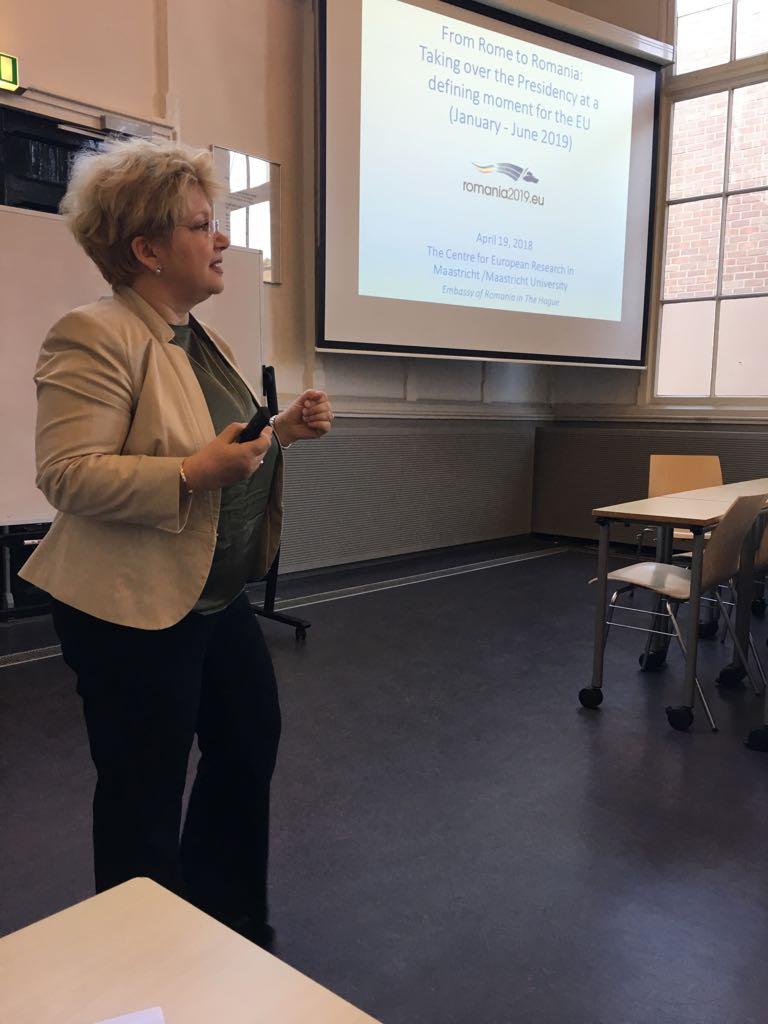
In her lecture, titled “From Rome to Romania: Taking over the Presidency at a defining moment for the EU (January – June 2019)”, Predescu gives a history of Romania and its relation with the EU. Starting in 1990, Romania established diplomatic ties with the European Community. Five years later, applied for EU membership and officially joined as a member in 2007.
It has been a little a decade since Romania’s accession to the Union and Predescu points out Romania has contributed to economic growth of the Union, is one of the most pro-European member states compared to the EU average, and remains a “regional stability pillar in a complicated region”.
Specifically on the Romania’s presidency of the Council of Europe, Predescu discusses the number of issues on their agenda, from monitoring the developments of Brexit to the institutional changes of the Commission and Parliament. She outlined two key priorities of the Romanian mandate: ensuring the continuity of the EU agenda and fostering cooperation between the member states and the EU institutions.
The lecture ended with a lively discussion between the Ambassador and the students, whom raised critical questions about the future of Europe and Romania’s goals and visions for the presidency.
Successful PhD Workshop on European Governance
The aim of the PhD workshop was to for current PhD scholars to present a draft paper on their research, where they will receive questions and feedback from their peers and senior scholars. Co-directors Thomas Christiansen and Ellen Vos gave the opening speech before the presentations.
In the first panel on current debates in the EU in terms of internal and external challenges, Jens Pohl (Maastricht University), Roila Mavrouli (University of Luxembourg), and Maria Patrin (European University Institute) touched upon issues of trade governance, European identity and its relationship with the immigration crisis, and the concept of collegiality. The panel was chaired by Johan Adriansen and Thomas Christiansen.
In the second panel titled “Relationships between the EU and its Member States”, Jitte Akkermans (KU Leuven) and Panagiotis Zinonos (University of Luxembourg), they looked at tensions in EU law vis á vis constitutional law. The panel was chaired by Anne Pieter van der Mei and Ellen Vos.
In the final panel on the topic of the European Monetary and Banking Union, Ute Lettanie (University of Antwerp) and Napoleon Xanthoulis (King’s College London) analysed the European Central Bank and the possibility of a European Minister of Economy and Finance. The panel was chaired by Aneta Spendzharova and Andrea Ott.
After the presentations, a short information session on how to get published was presented by Thomas Christiansen. He offered tips, insights, and possible difficulties in getting published. The speakers will be revising their papers first for CERiM’s Online Working Paper Series, which we expect to receive in the coming weeks. We would like to thank the speakers and chairs participating in the event.
Summary of CERiM Informal Event on Awkward Membership in the EU
In recent years, some Member States of the EU have turned in ‘awkward’ members who increasingly context the EU’s rules and authority, or even their belonging to the block itself. The United Kingdom’s decision to leave the EU, but also the Polish and the Hungarian cases are illustrative of these tendencies. More generally, Euroscepticism is on the rise in numerous Member States.
How can and should the EU react in this context? How have other Member States behaved?
To address these questions, we invited a panel, chaired by Monica Claes, of four speakers to discuss developments in Hungary, Poland, and the UK. Each speaker gave a short presentation before opening up the floor to the audience. Ferenc Laczo (Faculty of Arts and Social Sciences) talked about current developments in Hungary since the 2010 elections and the growing unpopular sentiments against the. Michal Natorski (UNU-MERIT) followed with a case study analysis of Poland and addressed the ongoing controversy about the domestic reform of the judiciary system. Matteo Bonelli (Law Faculty) offered some insight on the tension between EU law and constitutional law and how EU member states sometimes struggle to reconcile the two and the role the Commission plays in enforcing the rule of law. Lastly, Simon Duke (EIPA) gave a nuanced perspective on how the current and common narrative of the UK being the awkward partner does not represent the full picture.
The lively discussion raised a numbers of questions and issues such the factors and conditions that foster increasing Europscepticism and what can be done to combat them, the extent to which the Commission can intervene in domestic issues that seem to go counter to EU rule of law, and evaluating the understanding of ‘awkward membership’ as not only referring to the UK but also current member states that have had a history of going against EU principles.
After the session, the speakers were invited to write a short blog on their thoughts and they will be posted as a short series of related blogs. You can find them here in the blog section of our website.

Summary of Jean Monnet Lecture with Peer Steinbrück
In his lecture titled “Germany’s Role in the European Union: Towards a Reform of the Eurozone”, he addressed three main developments that characterise current politics: firstly, we are no longer in the post-Soviet ‘era of peace’, secondly, power vacuum left by the withdrawal of the United States from the current state of politics, thirdly, the rise of China and its silk road investments, fourthly, the rise of failing states, the refugee crisis and its impact on societies, such as the rise of right-wing political sentiments. Overall, Steinbrück solemnly declared that “Europe is not in a good condition”.
In surveying the current state of play in Europe, he identified nine main challenges that, depending on how they are dealt with in the coming years, will determine the future of the EU:
- Stabilisation of the European Monetary Union
- Completion of the Banking Union
- Continental Europe needs to elaborate on a coherent common foreign security policy (Russia, Eastern Europe, Africa, etc)
- An agreement and strategy on the distribution of refugees in Europe
- Strengthening of Frontex to secure external borders as the burden has been left to Greece and Italy
- Current foreign aid policy towards Africa needs to be reformed
- Combat tax evasion and avoidance, perhaps through the harmonisation of tax systems in Europe
- Reform of European institutions
- Principle of subsidiarity should be pursued by the Commission as they should be responsible for cross-border issues but not for national issues
On specifically how Germany intends to address these challenges faced by Europe, Steinbrück did not have a solution but offered an explanation as to what might work and what might be a model for other member states to follow. He reflected on the current German government and characterised it as committed to a pro-EU agenda, the free market, and supporting the social market. However, on the handling of financial turmoil, Germany works under a contrary paradigm to that of the Mediterranean model: short-term and goal-oriented reforms compared to deficit spending. As there is much dissatisfaction, and resentment even, towards how the Greek financial crisis was managed, Steinbrück suggested that a fundamental change in paradigm in crisis management is needed as this impacts European solidarity. Furthermore, given Germany’s heavy export market, which makes up a large share of Germany’s GDP, Germany has a responsibility to ensure that its neighbors are doing well.
After his lecture, Steinbrück took questions from the audience, leading to a lively discussion and sharing of his thoughts on topics ranging from Germany and its role in European security, the future of social democracy with Germany and France’s current relationship as the example, the likelihood of a coherent European foreign policy towards Russia and China, the possibility of a European finance minister, the possibility of enlargement of EU monetary and membership, and the likelihood of harmonisation of tax rates in the EU.

Report from Workshop on EU Policy Evaluation
Just before carnival, Paul Stephenson (FaSoS), with Prof. Frans Leeuw (Law), held a workshop at Campus Brussels on Policy Evaluation in the EU. They welcomed 46 participants over two days for 22 papers over 8 panels: a mix of junior and senior academics, and various practitioners from the EU institutions and beyond, including the European Parliament, European Commission’s Joint Research Centre, the Regulatory Scrutiny Board and European Court of Auditors.
The workshop was co-financed by the Centre for European Research in Maastricht (CERiM), FASoS Research Stimulation Fund (RSF), Stichting Universiteitsfond Limburg (SWOL) and the Law Faculty of Maastricht University.
The aim of the workshop was to stimulate debate on approaches to policy evaluation in the EU by bring together EU policy researchers with scholars from the evaluation community. We sought to explore conceptual and methodological approaches to engaging in evaluation, and to take critical perspectives on current evaluation practices in the world of policy making and implementation. Research papers were encouraged on the following themes:
-Approaches to EU policy, programme, or project evaluation
-Ex ante, mid term and ex post perspectives on policy analysis, including monitoring
-Theories, concepts and frameworks applied in the evaluation of EU policy
-Perspectives on effectiveness, efficiency and economy in EU policy studies
-The link between implementation and evaluation and/or evaluation and agenda-setting
-Gauging success and failure in EU policy analysis, including framing and discourse
-Contributions from different perspectives on evaluation, and in particular, realist evaluations of policy making and implementation
-Evaluation actors, institutions and evaluation culture in the EU
For the list of papers and panels please check the CERiM website. For pictures of the event, please find them here.
19 March 2018: Jean Monnet Lecture with Peer Steinbrück
On Monday 19 March, the Centre for European Research in Maastricht (CERiM) is pleased to welcome Peer Steinbrück, the former German Federal Minister of Finance and 2013 candidate for Chancellor, for a lecture on ‘Germany’s Role in the European Union: Towards a Reform of the Eurozone?’.
The format of the event will be a 45 minute lecture, followed by a round of Q&As by the audience for the remaining time.
Date: Monday 19 March
Time: 18:30 – 20:00
Location: Aula, Minderbroederberg, 4-6 Maastricht
Bio of the speaker
Peer Steinbrück, member of the Social Democratic Party (SPD), was Federal Minister of Finance (2005 to 2009) and Prime Minister of the State of North Rhine-Westphalia (2002 to 2005). In 2013, he ran for Chancellor as opposition candidate but failed to carry the election. Having resigned from his mandate in the Bundestag in September of 2016, Peer Steinbrück now engaged in the founding of the Bundeskanzler-Helmut-Schmidt-Stiftung. As economist by training, he was Head of the office of the Minister President of North Rhine-Westphalia, Johannes Rau, from 1986 to 1990. In 1993, he became Minister of Economic Affairs and Infrastructure in the state of Schleswig-Holstein. He then returned to North Rhine-Westphalia, where he became the Minister of Economic Affairs and Infrastructure in 1998 and Finance Minister in 2000.
 Centre for European Research in Maastricht